


Visensia® – The Safety Index™ is a new piece of clinical information that can be helpful to physicians and other caregivers. It identifies crises earlier and enables clinical teams to detect subtle signs of deterioration in a patient’s condition earlier and intervene sooner before problems become life-threatening.
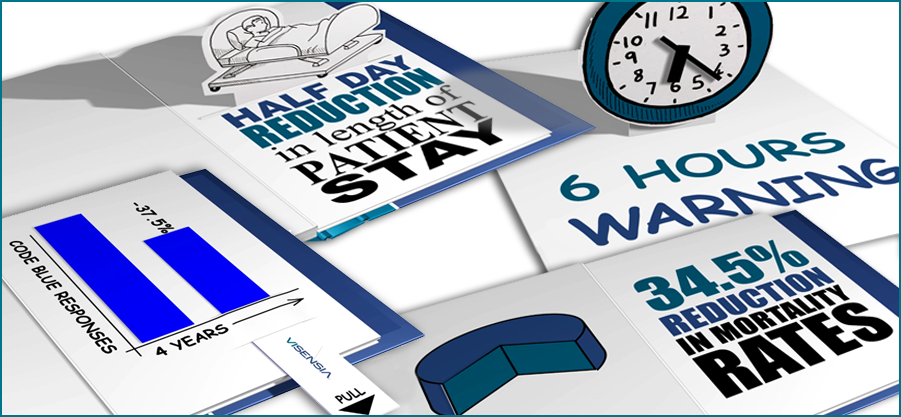
While warning times vary greatly from patient to patient and from hospital to hospital, in clinical trials the average warning time when combined with continuous vital sign monitoring was over 6 hours before the MET would have otherwise been called.
This early and accurate lead time has been reported in real world hospitals to have numerous benefits:
[accordions id=”10652″]
There are also a number of additional benefits demonstrated during evaluations of the Visensia Safety Index:
- Improve patient triage – In the United Kingdom and elsewhere, Visensia is being evaluated to assist ambulances and emergency rooms to triage patients. It has been widely reported that in certain parts of the NHS, ambulances can queue up outside a hospital for 12 – 24 hours before the emergency room can accept the patient. During this time the emergency room does not have great visibility into the condition of the patient in the ambulance, and there is growing interest in using the VSI to assess or “triage” those patients quickly in order to prioritise cases, reduce waiting times and improve efficiencies.
- Allocate scarce nursing resources – The patient severity reflected in the VSI can guide nursing managers to reallocate staff from wards with few elevated VSI scores to those with a larger number. Today there is no other FDA cleared tool which permits this type of management and prospective customers, particularly in the US, are very interested in this aspect of the Visensia system.
- Lower hospital liability insurance premiums – In conjunction with an international hospital liability insurance carrier – Beazley Plc based in London – the Company has been authorized to discuss decreasing hospital liability insurance for institutions using Visensia Safety Index to manage seriously ill patients. After a presentation of the Company’s clinical trial data, OBS has been able to negotiate an arrangement to reduce liability premiums for hospitals using the Visensia Safety Index by up to 10%.
- Improve Joint Commission scores regarding alarm management – JC has required hospitals to develop and implement alarm fatigue management strategies. As Visensia typically alerts before key vital signs alarms, Visensia can play a major role in helping achieve the JC recommendations.
Note:
Improvements in each hospital will depend on multiple variables that are very hospital-dependent including, but not limited to, monitoring and workflow processes before VSI installations, the severity of patients being treated and the modifications made by the hospital to respond to the VSI.
It is important to remember that VSI performance will be different in each hospital. Each of the claims above needs to be viewed as an attempt to quantify the size of a shift in hospital economics/practices, but the direction of the shift is the most important part of the claim.

1. Tarassenko L, Hann A, Young D. Integrated monitoring and analysis for early warning of patient deterioration. British Journal of Anaesthesia. 2006; 97: 64-68
2. Hravnak M, Edwards L, Clontz A, Valenta C, DeVita M, Pinsky M. Defining the incidence of cardio-respiratory instability in step-down unit patients using an electronic integrated monitoring system. Archives of Internal Medicine. 2008; Vol 168 (12) 1300-8
3. Hravnak M, Edwards L, Clontz A, Valenta C, DeVita M, Pinsky M. Impact of an electronic integrated monitoring system upon the incidence and duration of patient instability on a step down unit. Abstract from poster presented at 4th International Symposium on Rapid Response Systems and Medical Emergency Teams 2008.
4. St Joseph Mercy – Oakland (SJMO) Press Release July 28th 2014. Records on file at OBS Medical.